Thursday, February 12, 2015

Sports Week = organized chaos at its finest

Remember that time, in Ghana, where I didn’t teach for several weeks due to a national teacher’s strike? No, there isn’t another teacher’s strike... but it is Sports Week!

In Ghana schools, physical education is not built into the class schedule. Rather, students can voluntarily be on sports teams and the school occasionally calls off classes (for a half or whole day) to play sports in the place of class. Sometimes, local schools visit each other to compete in specific sports (during those half/full days off).

Then, in second term, there is an entire sports week. So, as you might have already figured, we have a whole week off class – a whole week dedicated to competing against other teams in the area. While Sports Week was officially this week, the teachers (coaches) have needed to train their players to prepare for this week... meaning that the past several weeks were so disorganized and classes were so irregular (with half of the kids gone for “training” or school simply ending mid-day to train) that I only taught 50% of the time. Being used to Ghana, I’ve adjusted to this lack of teaching by hanging out with the 4-H pigs and reading Harry Potter.

This year, sports week was held in the next town over, Bunso. The Saviour students (both JHS and Primary) were hauled in a tro-tro (12 passenger van) on Tuesday, squished 2-3 to a seat, for a 20 minute ride of them singing songs loudly and in incredible rhythm. I sat in the hot sun with 2 elementary kids on my lap in the front seat and smiled as they sang the Saviour School song – it was the first time I had heard it! Upon arriving, in clown-car fashion, the students piled out of the van and ran into the “park” or school yard set up for sports activities. The hiplife music was already blasting with the well-established sound system. Food vendors (AKA ladies selling food out of Tupperware on their heads) were everywhere. Schools intermingled, noted by the varying colors of local school uniforms. Goats occasionally wandered through the fields. In summary, it was the most organized chaos I’ve experienced so far in Ghana.

The Saviour Primary School Soccer team... and other random photobombers
Now let’s turn to the sports themselves. As should be expected (for just about every other country than the US), soccer was the most popular sport. The full-sized football (soccer) field was already surrounded by tents and chairs for the teachers when I arrived, and hundreds of school children closely watching the movements of the well-dressed athletes. Any time a team scored, the majority of the fans (aka classmates) of the scoring team would run onto the field in celebration, sending up a cloud of dust from the red African soil.

Soccer is intense in Ghana... even on such scruffy turf.
Apart from soccer, the most popular sport for these youths is netball. Netball, played by girls, is a unique African rendition of basketball – however, because the ground you are playing on is most likely not conducive to dribbling, you pass the ball in the air. Also, because it’s Africa and women are tough, there is a lot of heavy contact in this sport. So, I would say that netball is like a mix of rugby and basketball. There are 2 metal “hoops” with no actual nets hanging from them (again, let’s be African-appropriate) spread across the field (about 3/4 the size of a typical basketball court) and the girls pass the ball – but they cannot carry it, meaning they get only 1 step in addition to their landing step to transfer the ball to someone else.
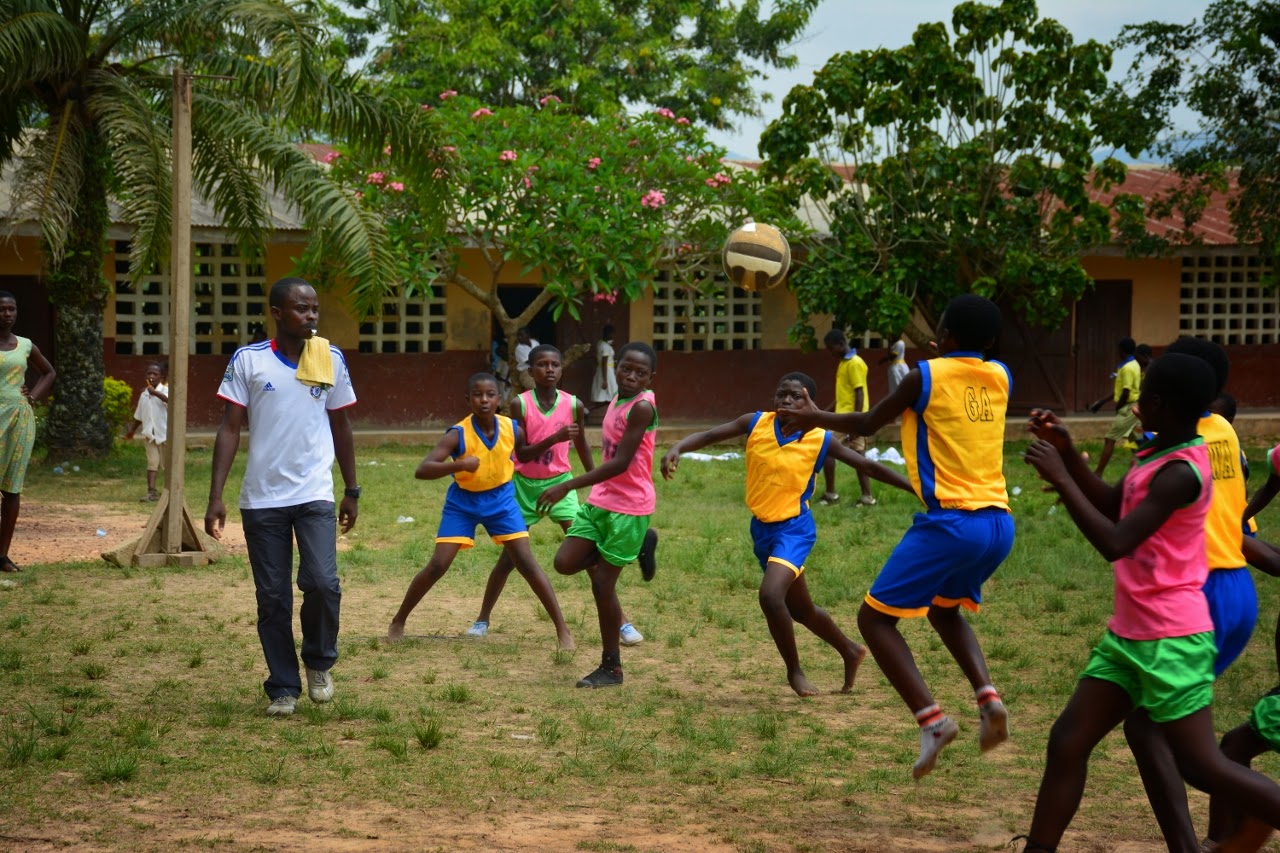
Netball = rugby + basketball. See the metal ring? No backboard or net = better accuracy.

There's also volleyball. One of my favorite sports, and one that can easily be adapted to Africa. Ghana volleyball is like US beach volleyball – the court is sandy. Other than the ground, though, it is identical to US volleyball. Students also participate in track events – short and long-distance running.

The Saviour JHS Volleyball Team - they know they be ballin'

Then there are the casual, schoolyard games that I learned while here (not played officially during sports week). Ampe is normally a girls’ game, whereby two girls “challenge” each other by jumping up and down, clapping, and stamping their feet opposite each other in a catchy rhythm. Once you get into it, it is quite a physically active game – not one I am about to challenge a 10-year old girl to anytime soon. Then there’s handball – the Ghana equivalent to what we know as “monkey in the middle.” You pass a ball to a friend/friends over the head of a single/several people, as they try to get the ball if you fail to throw or catch properly. Finally, there’s dancing! All Ghanaian kids know how to dance, and dance super well. Give them a beat (or let them make it themselves) and their genetically-present musical-dance talents will shine. I’ve heard from several Ghanaians that white people can’t dance (although they love it when I try) and I don’t feel offended at all – obronis really can’t dance the same way these Ghanaians rock out (impressive pelvic thrusts are commonly seen in kids as young as 1-2 years old).

Anyways, back to sports week. Games were organized between local schools for both the primary and secondary level. Playoffs are organized, then a school claims the prize of winner for each sport. The soccer JHS winners get to take home the area “trophy” for the year... I sure hope Saviour gets to bring it back this year! They won the first soccer match and made it to the playoffs, but I didn’t get to see the championship game.

It’s been a nice little break, but I need to get myself back on track for next week – however, I am told that the Independence Day celebrations (March 6) take much preparation. Who knows when I will get to have a “normal” school week ever again? I just take it as the day brings it – and I look for those chances to SEE these kids and invest in them. Last week, when classes weren’t really going on, I hosted a few Spanish sessions for some form 3 girls who were super interested. I also helped clean the pig pens when I was supposed to be teaching (given there were no students in the class) and I am also visiting the Saviour Senior High School to help them start a 4-H club. More about these happenings and other life reflections in the next blog... keep in touch! 


What more could a teenager want than a Ghanaian Sports Week?

Wednesday, January 14, 2015

The first time I've added a blog addendum

Second term. Week one. Second day of school.

The first day ways yesterday: Students aren’t learning yet – there isn’t much teaching going on. The headmaster’s corn was ready to harvest, so he used his pupils productively and sent them to harvest and carry the corn back to his front yard (which is also the school yard). Then, a communal “husking” occurred in the evening – simply another way for the children to show respect for their elders and serve the ones who are sharing knowledge with them. This concept (unpaid labor) may seem extreme to you and me, but it’s a way of life here. Students often help their teachers by working in their home gardens, helping on their farms, or cleaning for them. It’s an expectation in a culture where adults and educators are valued – thus children are taught to serve them.


Other than re-learning these cultural norms, I’m generally readjusting to life in Ghana. I left Osiem about 4 weeks ago to take my vacation and travel to Europe to meet my parents. We passed Christmas in Barcelona, New Year’s in southern France, and ate a LOT of pastries. It was almost too good to be true, mainly because I was allowing myself to be spoiled by my loving parents who (mildly) pitied me and my volunteer “salary.” We toured the cities, saw a bunch of churches (typical Europe), drove through the countryside, ate delicious food (paella, tapas, grilled duck, McDonald’s), drank red wine and coffee, walked on the beaches of two bodies of water (Mediterranean and Atlantic), and enjoyed sleeping in. I tasted the oranges of Valencia, devoured the tapas of Madrid, toured the Gaudí structures of Barcelona, entered the Arena de Toros (bull fighting ring) of Pamplona, got a pair of Spanish leather boots, spoke a LOT of Spanish (which was awesome), savored French macaroons, and saw the vineyards of the Bordeaux region. I also, of course, captured lots of photos. There are some selected ones on my Facebook page and a few (camera photos) here – more to come on my photography website soon!

A view of Barcelona from the tower of an enormous church near our apartment
One of the several gorgeous churches - this one, in Cordoba, was at one point made into a mosque (it was built around the chapel), then back into a church
Merry Christmas! We had an apartment in Barcelona and were able to cook a legit dinner: pork loin, mashed potatoes, fresh salad :) It was lovely. 
Why yes, I did enjoy that Nutella latte and chocolate cake #firstworldluxury #spoiled

Overall, it was a wonderful experience. Of course I was happy to see my parents again and share my African life experiences with them. I quickly slipped back into a lifestyle of material comfort in a place where tasks are generally easy to complete. I left behind the struggles and frustrations of my life in Ghana and didn’t want to have to face them until the New Year...

But then I came back to my Ghanaian home and was forced to confront those things I had set aside for 3 weeks – unachieved goals, poorly executed projects, stressed relationships and other effects of my pride. Upon reflection of my goals, I felt discouraged by the number not met yet motivated to re-invigorate them. Hopefully this term will be filled with 4-H members taking the lead, new club and home projects, increased profits of the farm, life skills development, and better networking in the school and community.

I am excited to be back in the classroom as this is one place that my (lesson) plans almost always follow through as intended. I am definitely growing as a teacher and learning that I enjoy taking knowledge and presenting it in creative and interesting ways to the students. I still have a long way to go to help them increase critical thinking skills and academic confidence, but I can see progress. I still have not had to use a cane to discipline students and I never intend to – they discipline themselves when they don’t engage in learning activities.

In other news, its dry season here in Ghana! What does that mean? Well, the “Harmattan” has come (Sahara trade-wind) so the air is dusty and dry and there is a thin layer of dirt covering everything. It hasn’t rained in over a month and my garden looks dreadful... but there is a positive side to the dry season (at least to obronis like me): it’s much cooler! Nighttime temps can get down into the mid-50s and daytime max temps only reach the mid-80s (but it feels cool due to the dry air and the fact that the sun is slightly shaded by the dust). I actually enjoy this weather to the humid rainy season, but the locals hate it – they don’t function well in anything below 70 degrees (so school is quite lethargic in the morning) and they complain about dry skin (even though there is still some humidity in the air) and coughing (which I experience as well). I have resolved to be happy about the weather, as it means I can snuggle under a blanket at night and wear long sleeves to school! Plus, I am not sweating all the time, so that’s awesome!

What else is there to say on this warm (but not sweltering) African January afternoon? I will proudly share that I was able to bring home a nice little stash of chocolate and real coffee (not nescafe) along with a French press – so my mornings are a little more encouraging with an extra burst of caffeine. As for the chocolate, it still surprises me that the #2 cocoa producing country doesn’t make its own (tasty) chocolate – just one more reason why it’s developing! So in the meantime, I will enjoy a bit of Hershey’s every now and then to keep me going strong.

Happy New Year! Or in the local language, Afeyshia Pa!

May the Lord bless you with encouragement in your struggles, friendships in your ventures, and opportunities to love others!

*An addendum to the above blog post, added just hours after I finished the main text*

Wow – talk about God’s timely blessings. I had been praying for encouragement in this time of adjustment and just as I was finishing my original blog post, one of my 9th grade students/4-H officers came in to talk to me. We have had a few semi-serious conversations in the last few weeks of school, but I never paid much attention to them. However, today he straight up told me that he enjoys talking to me and wants to learn as much from me as he can while I am here so that he can be more like me! I have never had anyone so directly tell me I am their role model, and by the way he openly and sincerely sought advice from me during our conversation (on everything from being a businessman to dealing with school peer pressure), I truly felt valued and significant. He even ended the conversation saying that he wanted to learn to be a better public speaker (and to improve his English) – which is amazing since I was planning to introduce a public speaking workshop for the 4-H club within the next month! I almost cried as we were talking and he told me that he looks up to me – let’s just say this was exactly what I needed. Praise God! He is faithful to answer prayers!


Okay, this really is the end of the blog post. 

Thursday, November 20, 2014

That frustrating moment...

That frustrating moment (or month) in the development worker’s career 

Yep, it’s happening. The honeymoon stage is over and I’m hitting walls and falling on to my butt in the dirt. The paths I thought I was going to explore are closed or I’ve realized I haven’t even made it far enough to enter them. But let me give you some exciting updates before I delve into the frustrations.

Wow. It’s been almost a month since I last blogged... time is flying here. I cannot believe it’s been over 3 months since we landed in Ghana. I also cannot believe that Christmas is just 5 weeks away! Normally, around this time, I would be preparing to sing Christmas carols as the snow flurries fell and Pennsylvania cuisine would transition to hearty winter foods. Because I’ve never lived in the tropics during fall/winter, I’ve been missing those key aspects of my favorite time of year: fall colors, pumpkin stuff, apples, cool weather, scarves, sleeping under several blankets, and fires in the fire place. However, I have to be content with the hot, sunny weather here and rejoice in the little things... like green beans!

The “minor” growing season is coming to an end here in Ghana, as we end the second rainy season within the coming month. Then comes the dry season: meaning more sun, more heat, and more dust. Right now, our 4-H garden is producing some small green beans, planted about 2 months ago. While there aren’t enough to market them, 4-H gave the first harvested handful to their white advisor yesterday – and man did those green vegetables make her evening! Vegetables are not often eaten fresh/semi-fresh here but are rather cooked down into stew or sauce. I’m super excited for when the lettuce comes! Plus, there may be some orange sweet potatoes ready for our AgriCorps Thanksgiving dinner next week! #thelittlethings

Well, the strike sort of ended about 2 weeks ago, so we’ve only missed 2 weeks of the 13 (ish) weeks of the first term. I’ve enjoyed being in the classroom again and am thankful for all the work that got done on the pig barn construction during the strike! It’s looking pretty snazzy with the walls and roof up. We’re almost ready for the pigs!

Check out the splendid 4-H Enterprise Gardens and Piggery Barn (we had just weeded the garden, hence it looks so nice)
In other news, Saviour 4-H was able to go on an educational field trip during the strike. We traveled to the next town over (about 7 miles away) to visit the Cocoa Research Institute of Ghana (CRIG). The 45 students who attended got to learn about the major cocoa varieties, see coffee trees (something that made the white people very excited), experience different cocoa seed fermentation methods, and visit the “flavor lab” where the wafting aroma of chocolate filled the air as they did some quality tests on the final product. If you want to learn more about cocoa, check out Dustin’s latest blog post.

Various Cocoa and Shea varieties grown in Ghana. Little did I know, shea is a completely different plant from cocoa, but its butter is often used as a filler in chocolate/candy bars (without you knowing)

4-H Saviour members on the trip to CRIG

Traditional sun-drying method for cocoa seeds
In other obroni news, the AgriCorps team got to see some pretty cool agriculture lately. We traveled to the Ghanaian version of the mid-west by visiting the African Atlantic Enterprise Farms in Afram Plains (region of Ghana around the Volta lake). The huge farm has several pieces of modern agricultural equipment not often found in Ghana: of these is a massive pivot irrigation boom that pumps water from the lake to irrigate the 40 acres under cultivation. Although the farm is still in its development stage, it is a very interesting approach of how Africa can capitalize on local resources (i.e. a lake and irrigation system) to maximize rural agricultural production.

The first thing that caught our eyes as we approached the farm... you'd think you were in Kansas, not Ghana
One of the village cattle, grazing as the sun set over Volta lake
This is Trip, the Ghanaian mascot of the Afram plains farm - he made my weekend even more enjoyable as he accompanied me on all of my explorations of the farm and surrounding area (note: I miss my dog, Bella)
Another exciting event was traveling to Kumasi (the second largest city in Ghana, behind Accra) for FAGRO (the Food and Agriculture Expo of Ghana) this past week. With over 30 vendors, some of which seem to be great partners for 4-H Ghana and AgriCorps, we had a successful trip. We also were able to tour a bit of the city, eat some good food, and stay in air conditioned hotel rooms for a couple nights! It was definitely a great get away.

I don't think I'll ever have another blog post with so much JD Green in it, but this still was exciting to see! John Deere has a great vision for African agriculture, and they're patiently waiting for mechanization to take hold.
A nice evening view of Kumasi from the walk to our hotel

Now time for the deeper reflections:

Change is hard. Period. Even if it is something small, humans usually have a difficult time adapting to change. Now think about coming into a completely new culture and trying to implement something that has never even been considered before. Sure, at first people want to change their habits because they are excited to have a foreigner working with them. But then they realize I am just another human with different ideas and they soon lose interest in change: so things start slowing down, going backwards, or hitting me in the face. Skills I thought I was sharing with the 4-H members have disappeared and I’ve begun to question my purpose here.

But then I realize this is an occurrence for anyone in development: change is gradual and patience is more than a virtue - it is essential for success. Perseverance, too, is a requirement to pursue these long-term changes. Although I find myself often discouraged after being in my community for over 2 months, I must remind myself that I still have 7 more months and these people have a lot of potential. The piggery project isn’t going as I envisioned it, club meetings are still disorganized, people aren’t keeping records, and teaching still seems to be about using the cane to subdue “disobedient” youth. Some of my goals have been met, but so many more sit untouched, taunting me as though they will be unattainable. Sure, it is discouraging, but I picked this career. As many of you may know, I am normally a results-driven person, but results look really different here: I must remember that patience and time are required for them to come. Then again, do I really need to see results to feel successful or of value? My mind tells me that I do, but my heart and faith tell me that I should not feel that way. My value doesn’t lie in what I do, but rather who I am and who I love. Development work isn’t about projects or products; it’s about people and processes. I’m not really in the business of agricultural development. I’m in the business of loving and investing in people: while they may be frustratingly different from myself and slow to develop the skills I know will help them, I must be patient and graceful in working with my community.

“Don’t judge each day by the harvest you reap but by the seeds you plant.” ~Robert Louis Stevenson


I'm just learning to live where I am.
Sometimes its the little things that get you through the day... like helping John fetch water when I went to visit him. I'm thankful that I don't have to carry 4 gallon buckets of water on a 5 minute walk up a hill on my head every day like he does! But it still was a fun experience!

Thursday, October 23, 2014

The best time to blog is when there is a national strike.

Well, it has been crazy busy here in Osiem, Ghana... until this morning, that is. Starting yesterday, a nation-wide strike of 12+ workers unions has ensued. The two national teachers unions are included in this, thus, teachers are not coming to school. With no teachers in school, there is no point to bringing students, so school was closed this morning with no certain re-start date. I honestly have no idea when the strike will end – it seems the unions are looking for pension benefits, so let’s see how long the government will hold out on the majority of its workforce.

In the meantime, a lack of classes gives me a brief chance to blog! Mind you, I am not sitting idle – especially since, as an AgriCorps volunteer and unpaid teacher, my job is still intact. But we’ll come back to that.

So it’s been about 3 weeks since I’ve last updated you – I thought I would have much more time to blog in Africa, but it seems this is not the case. Since classes started 3 weeks ago, I’ve been moving from sunrise to sunset. Between planning and teaching five 35-minute classes a day, two 4-H meetings a week, a district 4-H advisor training, test taking (for the students), a weekend AgriCorps training, day-long power outages, and visits to my fellow Corps members, I haven’t had much down time. But I suppose this is better than being super bored and feeling deficient – something that may creep up on us if this strike lasts long.

Amidst all the activity, I am continually being affirmed as to why I am truly here – I’m here for the students. How is this different than being an ag teacher/FFA advisor in the states? Well, it really isn’t that different – young people are hungry to be seen, heard, and invested in. It doesn’t matter if they are poor Ghanaian middle schoolers or middle class Pennsylvanian high schoolers. They simply desire to be valued. Teachers all around the world have the extremely significant task of loving on youth. Here in Ghana, I’ve found that this does not look the same as in the U.S. The hierarchal structure here has children as inferior to adults and therefore completely submissive to the teacher’s authoritative role in the classroom – this can be visualized by the “cane.” Teachers in Africa (similar to teachers in the U.S. about 50 years ago) are the center of the classroom, thus instruction is centered around them. If there is a learning disruption or lack of submission to the system, students are “caned” (whipped in the backside with a long, flexible wooden rod). Teaching usually involves lecture and copying of notes, with question asking as the most common method of checking for understanding. However, in classes of 40-60 students, not everyone gets the chance to answer questions – so the stars shine and the slower students sit quietly.

Mind you, teachers are not heartless beings – they generally care about their students. But caring about youth here means that you teach them to be disciplined and respectful to their elders – something that we often neglect in the U.S. I’ve come to respect the way that children are always willing to serve their elders (even if it is another youth just a few years their senior). I feel as if I don’t deserve the service from these children since I didn’t really have to serve my elders in the same way when I was a youth...

Regardless, student-centered instruction is scarcely seen here. Thus, the student learning “activities” I have utilized so far have been widely accepted by the youth and even misunderstood at times (i.e. these students have never been asked to “teach” their peers, so a small group teaching activity wasn’t quite grasped at first). One of the most rewarding results of my desire to use experiential, student-centered learning has been a comment by one of the 9th grade students. He came up to me about 2 weeks ago and said, “Madam, the way you teach agriculture in class – it makes me want to study agriculture at university. I want to learn more and become a successful agriculture scientist and you have made me believe I can do that.”

I wasn’t expecting to see many fruits of my service here, but that one was pretty huge – powerful enough to motivate me for another 8 months!

Another exciting event has been the success of the 9th grade class on their animal digestion exam. They took the test this past Friday and, as opposed to the normal test average of 50-60%, the class average is 79%! I was so proud to give so many stickers to those who scored an A (80%) or higher and especially proud that some of the top scorers were the executive officers of the Saviour 4-H club!!

Okay, I’m done bragging about the 9th grade class. But I really am proud of them – I have a lot of fun teaching them, even if it is a class of 64 students. Let’s hope this strike ends soon so we can get back to the unit on soil and water conservation (one of my favorite topics)!

What else is happening? Well, 4-H Saviour is receiving funding from the head church pastor (who is also a nationally renowned cocoa farmer and member of the Ghana presidential council) to build their pig rearing structure! We hope to break ground next week so that the piggies can arrive in early November! Hopefully we can be productive with the free time during the strike to really get moving on this project, along with several others. However, I do realize this isn’t a sustainable model (wait for school to be canceled to do all the work...). Oh well, we’ll be opportunistic! More updates/photos to come on the pig project!

As I observe other teachers and get frustrated with them beating children, I realize that I cannot make them change their ways. I am attempting to demonstrate student-centered, youth empowering strategies that will hopefully be picked up and adopted here. Thankfully, I have a very understanding and adaptive counterpart who I hope will continue to use innovative teaching methods. I’ve been telling him, any time he complains about Ghana or poverty, that change starts with him changing his actions. This is how I am trying to live... You all know the famous Ghandi quote, and its ironically painted on the wall of our school library (by a previous U.S. educational volunteer group): 

“Be the change you want to see in the world.”

Students will be successful. Students will be seen and heard. Students will be life-changing leaders. It starts in a student-centered classroom. 

Here are some long-overdue photos to update you on other exciting things!

4-H members planting seeds in the nursery of the school garden! Not all the seeds germinated, but it definitely looks better than it did in August!

I do enjoy African food... but this was super special. I made an American dish with boxed mac n cheese from Koforidua, sausage (hot dogs) and a fresh vegetable salad!


2 week ago was a special entertainment event (AKA dance party) for the whole school, as planned by the 4-H Saviour Entertainment/Recreation committee!

This may not seem like much, but it is me using my first ever personal machete!! And I am making a mound for pumpkins in my first ever personal garden!! 

Dustin and Blaze leading some Parli Pro discussions at our district 4-H advisor training

My first ever Ghanaian wedding! It only lasted 3.5 hours :)

Eunice is another 4-H advisor - here she is reviewing all the Parli Pro concepts I had just taught to our members... but in their local language. I think it went well!! 


Thursday, October 2, 2014

"Do you understand what I am saying?"

When I asked the 9th grade class how my English is different from theirs (referring to the fact that they spell esophagus with an "o" because they speak/write in UK English), I was told that "you speak fast" and "please, madam, your English is very deep." Because I had previously received the "deep" English speaking comment from a taxi driver, I knew it meant my accent is simply very different from theirs. However, I don't want this to get in the way of my time here - so I constantly ask the question above: "do you understand what I am saying?"

This week is my first week of teaching students!! Time for another student quote:

 “You taught so different than what we were used to. The African teachers, they don’t do what you did. What you did – when you gave us the papers to match them and made us work through the processes in groups – I know I will remember the content better. I will think back to the lesson and say ‘this is what madam taught us.’ And the lesson, it went by really fast... we enjoyed it very much.” ~9th grade student and 4-H member referencing the first lesson of a unit on animal digestion

Time to throw some credit to my wonderful teaching preparation program – Penn State Teach Ag (Agricultural and ExtensionEducation)! Without such great advising and emphasis on diverse teaching styles, I would not have received such encouraging remarks from these students – Thanks PSU AEE!!

A lot has happened since my last blog post – I am surprised to find myself claiming that I have been pretty busy over the past few weeks. Actual teaching (for me) began this week, and thus far I havem taught the first lessons of the 9th grade animal digestion unit and the 8th grade human reproduction and growth unit.

Yes, I am teaching 8th graders about human reproduction. But I am super thankful that the first lesson wasn’t as awkward as I expected it to be: I drew the male reproductive system on the board (on my first day of teaching) and taught them about each part and its function... and nobody giggled! Either they didn’t really know much about the system before I taught it or they are super afraid of this obroni (white foreigner) and don’t want to risk laughing in class. Regardless, it was a pretty successful lesson! I know I still need to speak slowly for these lessons, but I was surprised at how much the children actually got from the first day’s content! I’m praying that they continue to be interested, I continue to think of creative teaching methods, and they remain respectful so that I don’t have to discipline them...

Just to brief you on discipline in African schools, it usually involves “caning” – using a flexible switch (wooden rod) to smack a child in the back or buttocks. While I cringed at first sight of this act, I soon realized it is an accepted means to discipline youth. Many people (students included) have asked me if I “cane” and, although I never want to have to hit a child with a wooden stick, I have told them that I am not afraid to discipline: this is where the cultural norms and personal ethical philosophy may clash a bit... so let’s just hope the kids are good and I never have to punish them (I know, I am dreaming)!

I said I have been busy – with what you might ask? Well, 4-H is in full swing! Since my last blog post, we have had 5 4-H meetings with member attendance averaging around 50 students! Students registered their home projects, I gave a lesson on record keeping, we had committee meetings (a new concept that seems to be pretty effective! Committees are animal husbandry, crops, and recreation/entertainment), and I facilitated the “human knot” activity. It was quite amusing considering boys and girls didn’t want to touch each other and they initially thought they were supposed to simply “pull” themselves apart... nonetheless, they achieved the goal after a few more tries and we had some entertainment.
First class - group time for the 9th graders!

Human knot!
Yesterday, we spent several hours preparing the school garden for planting. A fence was erected around the sides, ditches were dug, the compost pile was turned, and the children cut down all the weeds. Then, upon completion of the work, we had some “entertainment” from the recreation committee – the chairman had a radio/speaker in the shape of a car and, with a USB jump drive plugged into it, he played various Ghanaian hip-hop songs while students danced in the garden. It made my night! Then I danced in the middle of the 40 or so children and they fell to the ground laughing... needless to say, seeing an obroni dance made their night: especially when I taught the “fisherman” dance move to my fellow 4-H advisor, Richard, and I reeled him across the garden.

There have been several other exciting things happening, but for blog length’s sake I think I will just list them for you!
  • I got a dresser! After “custom” ordering a simple dresser from the carpenter in the next town 3 weeks ago, I now have a legitimate wooden dresser to put all of my clothes and things in (rather than living out of suitcases for a year). It’s not nearly as high quality as my father’s handiwork, but it will certainly do its job (especially for the price I got it!). My room now definitely feels like home.
  • My little “brothers” now have American toys – I gifted some Hotwheels cars to them that my mother sent in a care package with Dustin (when he went back to the US) and now they only play with them. While they enjoy them, I am noticing they were content without these toys and didn’t fight as much before I gifted them... an interesting discussion on materialism to be had later.
  • Over 60 students came to the house the other day to clear the grass in the front yard as a favor to Richard. While cutting, someone injured and killed a decent sized lizard and they brought it to me... so I did what any science teacher would do and dissected it (using 2 machetes wasn't the easiest way to do so, but it worked)!
  • One of the 9th grade JHS students, who is the chairman of the animal husbandry committee, gave a wonderful speech to over 200 people at yesterday’s PTA meeting, requesting support from the community for our piggery construction project! I was so proud.
Today marks 1 month since moving into Osiem... time has flown by. And I know if I don't keep my eyes open and on our goals for the year, these next 8 months will disappear before I know it!

My dresser... strapped in the back of a tro tro for the 20 minute ride from town. I was super nervous...

Thursday, September 18, 2014

First day of school... in Ghana

Not to be confused with my blog post from the first day of school as a student teacher in Wellsboro - because there are several differences between the two places:

1) School started Tuesday... but there was no teaching. In fact, there were few students in classrooms. Most students were outside, either playing (elementary school) or cleaning the grounds. This includes:
  • cutting the knee-high grass around the school buildings with machetes (boys, ages 8-18 were partaking in this)
  • sweeping the classrooms, corridors, and sandy areas with hand brooms (girls of all ages were doing this)
  • cleaning up the litter (the waste management system in Ghana is still developing... thus waste is commonly tossed on the ground)
  • organizing desks and classrooms 


In Ghana schools, there are no custodians: the kids are the groundskeepers. I will reflect more on this aspect of Ghanaian culture in a future post, but let's just say it is a pretty ingenious structure to build life skills and a sense of responsibility for these kids and their place of learning. However, that does not negate the fact that learning wasn't actually happening on the first day... 
Anyways, all of this was readily occurring with a gentle roar of children uniting after 2 months of vacations. They were all in their pink and green uniforms (which coincidentally match the colors of the school buildings) and seemingly all hard at work... until it rained. 

2) Major differences also lie within responses to weather. In the U.S. (Wellsboro) we have snow days. In Ghana, we have rain days. Because 95% of the kids are walking to school and 80% of those kids don't have rain coats or umbrellas, school doesn't happen when it is raining. How hard must it rain for a rain day? Well, I would say if it is any heavier than what we would consider a steady "spring" rain, students aren't expected to be at school. There is no notification system, but they handle things well: if it is raining at 8 AM (school start time) and stops at 9 AM, you should come to school ASAP (i.e. 1 hour delay). If it keeps raining past 10 AM, you aren't penalized for not coming to school that day (i.e. more than a 2 hour delay). The weather here is about 75 degrees and pretty humid. I will note that it rained pretty hard for 1 hour this morning, then mildly hard for 3 hours this afternoon. It got pretty cool this evening (72 degrees) so I wore a jacket to go out... mind you, this is nothing compared to the -15 wind chill that welcomed me in Wellsboro this past January. :) 

3) I didn't have much to do during my first day. Teachers were running errands/registering new students. Kids were all over the place. My colleague/fellow 4-H advisor left me for several hours... so I just chilled in his classroom with some of my 4-H girls for the majority of the day, teaching them some songs and looking at pictures. I know this was to be somewhat expected due to the Ghanaian culture and sensitivity to time, but I would have hoped to do a bit more. Classes are actually expected to start next week (after a Monday holiday) so I will hopefully see some pedagogy then. 

While my first day of school in Ghana wasn't anything like my previous first days of school, I have had some awesome successes over the past week! Now all moved in and a week-long resident of Oseim, I have been able to engage with 4-H and the community almost every day. 

Last week I visited some more farms with Dustin, a fellow AgriCorps member, as he came to visit my village. We also helped set up the first "home entrepreneurship project" of the year! Samuel is the 4-H lead secretary and he set up his project on a small plot of land outside his house (which is about 300 yards from mine). We constructed about 8 raised beds for carrot production, with the 4_H advisors, Dustin, and the larger kids sharing the hoe and pick axe. Because everything is about community in Ghana, we had about 30-35 observers at all times. We put the small children to work picking trash out of the garden, and I got distracted by some of the babies... but it was a beautiful success! 


Later in the week, I met with my 2 other 4-H adviors to review some key aspects of the club and some major goal areas for the year. I am super excited about what is to come! While I know it will be hard to stay on track with some of the dates I designated for goals, I know there are motivated and supporting people here to make things happen. 

Saturday was the Sabbath at Savior Church (the church that founded the school) and it was also my prepared "Community meeting." AKA about 80% of my 4-H members and their families go to church and were present among the 500-600 people at the service where I introduced myself. I spoke to them a bit in their local language (they laughed), said that I loved their food (they clapped), shared about my 4-H and farming background, then stated my purpose for being here for the year (they seemed to fall asleep a bit...). Overall, however, I think it went well! The community is seriously very welcoming and gracious - I already feel at home here. 


On Sunday evening, we worked in the school garden for a bit... then continued into Monday morning: weeding, cutting, clearing the land. Based on a recommendation from myself about the mass amounts of green cuttings/weeds they were pitching, we made a COMPOST PILE on Monday! My first ever 4-H "lesson," to about 30 students, was a success! I shared that compost = air + water + nitrogen + carbon + microorganisms then, after they all correctly answered the "quiz" questions to check understanding, we got to making a 8 ft by 4 ft compost heap! It's pretty massive... I hope it turns out well! 


Wednesday was quite a bit more productive compared to Tuesday - we had a 3 hour staff meeting for the teachers to be assigned their classes, then a good 4-H executive meeting! I am getting excited for Friday's general member meeting, the first of the year! More to come later!


Monday, September 8, 2014

On the edge of the diving board


You know that moment when you are standing on the edge of the diving board? It’s when you’re hovering over the 12 foot deep pool of water deciding how to best execute the dive – there is excitement, anticipation, a vision of how your dive will look, and maybe a bit of anxiousness over the potential for messing up.

That moment is now.

The past 6.5 weeks of training, transition, excitement, stress, and growth have brought us to this point – we have been training to dive in to our true year of AgriCorps service. While we may have been mentally preparing ourselves for a Liberian pool filled with post-war problems, little to no educational structure, and a very physically challenging environment, we are now finding ourselves standing at the edge of a decently attractive Ghanaian pool – this one with a bit more educational structure, a strong 4-H foundation, and much more room to swim around. I can already see the positive impact of diving in and I can clearly see myself diving deeper than I would have expected to in Liberia.

We have been in Ghana for 3 weeks now. So far, we have had cultural/language training, agriculture training, and we got to go to our our villages for a set-up/scoping visit this past week. Then, after the 4-day village visit, we reconvened as a team in Koforidua for a weekend of review/final training. Although all of us were ready to “get to our village” for so long (because we literally have lived with each other for 6 weeks straight), we certainly were excited to see each other after just a few days apart – mainly because we were all so anxious to share about the awesome things we learned from our placements!! Let me share some of 
  • My new home is great! My “host family” is a young couple with 2 small boys under age 6. The father, Richard, is my “counterpart” and one of the 4-H advisors for Savior Junior High School (JHS). He is great to work with and his wife is eager to teach me Twi and how to cook, etc. so I am super excited about this new home and my cheery, spacious room.
  • My 4-H club is rocking – it is seen as one of the most advanced in the region in terms of size and scope. The kids have been so welcoming (AKA at least 5 visited the house every day I was there last week) and one of my officers has even started a home garden project even before school started!!
  • The community is fantastic. Oseim (my new town) is a genuinely welcoming place and the Savior church community seems like a great area. People are kind and always willing to greet me or help me. I held a successful stakeholder meeting last week with some key persons in the school and community and everyone was willing to work with me and 4-H to improve the lives of the youth and farming community.
  • There is already stuff happening... just because they have a foreign volunteer! While at first I doubted that my presence or work would bring much visible “fruit,” I learned quickly that the fruits are already present... even before my official start time! There is a very prominent Cocoa farmer in my town who is also head of the entire Savior church in Ghana. He is currently in the U.S. for a conference or event (as he is the World Cocoa Foundation President) and will be back soon, but he apparently is excited to meet with me. Plus, he donated about an acre of land for our school 4-H to expand its garden program... and he did this before I even arrived! Even more, there are some larger animal farmers in the area who are willing to donate pigs and rabbits for our 4-H to start one of the first school animal raising projects in the region!
  • My school and community have high expectations of my time in Oseim – this is where the “anxiousness” of diving in is sourced. I know I will not have all the answers: I will mess up. But I am still so excited to work WITH the youth and community to empower them for sustainable agrarian and economic change... and let’s not forget how many awesome public speakers will come from Savior 4-H by the time my year is over!
I am sincerely excited to dive in to my year of service. There will be problems and barriers: I will get frustrated with the relaxed culture, especially in professional settings. I will miss home and I will feel lonely. I recognize these things, but I embrace them for they will allow this new “job” to be an all-encompassing growth experience.


So what next? Well, after a lovely weekend of team reflections and preparations (and some down time at an ACTUAL pool at a local hotel), I am ready to head back to Oseim tomorrow to GET STARTED! Classes start next Tuesday (September 16) and I have no idea how school will look or what my teaching will look like, but I will be teaching integrated science classes.

Here I stand at the edge of the board. The pool of opportunities is huge. Room for impact is unknown yet promising. I am ready to dive in.

And now you get to enjoy photos of the last 2-3 weeks, since I was unable to upload them for my last blog!

This is my school's 4-H garden!! Check out that welcome sign.

Ag training in Atiwa district (2 weeks ago) with extension officers

That time I wanted to do individual farmer interviews and my counterparts set up a meeting of 11 farmers with me and 14 farmers with Melissa... It didn't go as smoothly as I would have hoped but it was fun to talk to them!

Piglets we may be getting for our 4-H program!! I am SO EXCITED! They have pretty nice structure and genetics!

Another local hog facility - some pretty nice stuff... 

Dog breeding at a local farm! They weren't quite pure bred, but they were cute.

This chicken farmer has 15,000 layers at his farm - he has been to ag trainings all over Europe and imports his chicks from Germany... crazy.

That one evening a herd of cattle made its way through our school yard... (note: cattle are NOT common here)


My cheery room and my new mosquito net! It makes me feel like a princess... really!

Good reflection and brainstorming occurred this past weekend in Koforidua with my AgriCorps family!

Check it out: I am starting to develop my own head carrying skills! I am excited to learn so much more while I am here!